
Hello everyone,
2026 is shaping up to be a year of significant and frequent changes to the NDIS, our states’ Foundational Supports and many other areas of our lives.
Changes can affect our wellbeing; both positively and in other ways. For most of us, change is something that needs to be co-designed, planned, well communicated, supported and evaluated. The Australian Autism Alliance Board of Management is committed to ensuring that the voices of Autistic Australians and our autism community are always present, heard and valued every time someone discusses a change that affects our lives.

To understand why we’re being bombarded with so many changes to the NDIS, we invite you to read below.
- The rationale behind the current NDIS 'reforms'
- Significant changes/reforms underway in 2026
- What our community is telling us about NDIS reforms
- A look at the NDIS: What their Dec ’25 numbers are saying
- At times of great change, our voices matter even more
The rationale behind the current NDIS 'reforms'
the NDIS is a big part of our lives. Now, the NDIS is going through some big changes that they’re calling ‘reforms’. It’s important for all of us to understand what these changes (or ‘reforms’) are, why they are happening, and what they might mean for current and future participants and others.
What does ‘reform’ mean to the NDIS?
Think of ‘reform’ like renovating a house. The house is still there, but you are making big changes to make it stronger, work better, and last for a long time. The government is reforming the NDIS with the goal of supporting Australians for many years to come.
Why are these reforms & changes happening?
The main reason is to make sure the NDIS is sustainable. This means making sure there will be enough money for the NDIS to support people with significant and permanent disabilities, now and in the future. Our federal government wants to slow down NDIS cost increases to make sure it stays affordable for the Australian people in the future. The government’ financial projections (below) show that these may grow from 50.4bn in 2024/25 to $95bn in 2034/25, if the proposed changes/reforms do not occur.
|
Scheme expenses ($m) |
2025-26 |
Projected 2026-27 |
Projected 2027-28 |
Projected 2028-29 |
Projected 2034-35 |
|
Total Scheme expenses (cash basis) |
$50,394 |
$53,627 |
$57,769 |
$62,076 |
$95,159 |
Source: NDIS Annual Financial Sustainability Report 2024/25, p 12. Accessed on 03/03/26
Here are some of the key reasons that the government has given for its current plans for changes/reforms:
- Making the NDIS last for a long time: The NDIS is one of the fastest-growing costs for the government. The reforms aim to make sure it can afford to keep supporting Australians for generations
- Getting back to basics: The proposed changes aim to make the NDIS focus on its main role, which is supporting people with permanent disabilities to live ‘ordinary lives’
- Clearer rules: New rules aim to help everyone understand how the NDIS can support them and what the NDIS can and can’t pay for
- Support outside the NDIS: The Federal government is working with states and territories to build more accessible supports in the community; many of these were removed when the NDIS was established, leaving lots of people without the “Foundational Supports” they’d been accessing
Reducing the cost of the NDIS: Costs of the NDIS, as it operates today, are considerably higher that originally estimated, due to inaccurate forecasting and misunderstandings of different disability types, incidence and the supports required for ordinary lives.
Significant changes/reforms underway in 2026
Two big changes will start to roll out this year.
New rules and a new way of planning for NDIS participants: From mid-2026, some people over 16 will have a new way of making their NDIS plan (click here for the government’s information on this). It will involve a ‘support needs assessment’ to better understand what supports are required for individuals. The government tells us that their goal is to make plans fairer and more consistent for all NDIS participants.
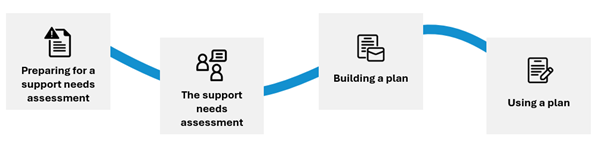
New Framework Planning Rules process, Source: Discussion paper, p 12. Accessed on 03/03/26
This ‘reform’ process is currently seeking community opinions and via consultations and submission (click here to visit the government’s page on this). The Australian Autism Alliance will be formally submitting to this consultation and participating in other national discussions. As always, you’re invited to share your opinions with us (via the survey link below), so that we may carry them to the government’s decision makers.
CLICK HERE TO HAVE YOUR SAY ON THE NDIS FRAMEWORK PLANNING RULES
Thriving Kids program: From October 2026, a new program called ‘Thriving Kids’ will be implemented across the nation (click here for the government’s Fact Sheet). This program will be for neurodivergent children aged under 9 with “low to moderate support needs” (their term, not our's!). It aims to provide support outside of the NDIS, in the community. Children with 'high support needs' will still be able to get help from the NDIS.
This was the topic of one of our community consultations in late 2025, and the Alliance thanks those of you who shared your experiences and opinions of the proposed Thriving Kids program. These were combined into reports and documents, and submitted formally to the Parliamentary Inquiry.
CLICK HERE TO READ THE ALLIANCE’S SUBMISSION ON THE THRIVING KIDS PROGRAM
The Australian Autism Alliance is constantly advocating for our community to ensure that the voices and lived experience of Autistic people and the autism community are being taken into account when decisions affecting us are being discussed and ‘reform’ programs are designed.
What our community is telling us about NDIS reforms
These NDIS changes/reforms have brought mixed feelings in the autism and disability community. Some of the most frequently mentioned pro’s and cons are briefly summarised below:
What people are hopeful about:
- Many people agree that the NDIS needs to be strong for the future
- Some welcome the idea of clearer rules and more consistent plans, hoping it will make the NDIS fairer for everyone
- The idea of more support in the community (like the Thriving Kids program) is seen as a good thing, as long as: it’s easy to access and provides the right supports, and no child is left worse off than they are currently under the NDIS.
What concerns people:
- Many families are scared and anxious that these changes will mean their support is cut. Some have already experienced cuts to their plans, which has caused reductions in vital support, a lot of stress and poor outcomes
- There is a lot of concern about the new planning process. People are reasoning that the government has not shared many of the important aspects of the “reforms” and how they will be implemented and the ways in which they will be tested to ensure positive reform. Some people are worried it will be like ‘robo-planning’, with inflexible computers making decisions instead of human experts who understand individuals’ lived experiences of autism and co-occurring conditions
- Autistic-led groups are worried that they haven’t been properly included in designing the changes. They, and we, are concerned that the new programs won’t be neuro-affirming or meet the real needs of autistic children and their families.
The Australian Autism Alliance is committed to ensuring that our government and those within it hear and act upon the voices and lived experiences of Autistic Australians and our autism community, at every stage in these ‘reform’ processes.
A look at the NDIS: What its Dec '25 data says
Every quarter, the NDIS publishes a summary of its activities and participant numbers and provides spreadsheets showing subsets for different primary diagnoses (found here). The Australian Autism Alliance team have been analysing the latest reporting (released in Feb ’26), focusing on some of the scheme’s data relating to Autistic participants.
The Alliance is always interested in knowing more about the profiles and experiences of Autistic Australians, and the autism community, so we can focus our advocacy, support and community engagement in the places where it matters most.
Referencing the NDIS’ Dec ‘25 data for autistic participants, here’s a quick look at what their latest numbers are telling us:
Increasing numbers of autistic NDIS participants
The NDIS is supporting more autistic people than ever before. There are now over 324,000 of us in the Scheme. It means that today, almost half of all the people in the NDIS are autistic. This shows how important the NDIS is for our community and how important we are to its effective operations.
Most of the new autistic participants are children and teenagers, with the biggest group being kids aged between 9 and 14. It’s great to see so many young people getting the support they need early on.
96% of autistic applicants were accepted into the NDIS
During the December 2025 quarter, when autistic people applied to join the NDIS, 96 out of 100 were told 'yes'. On the one hand this is positive and on the other, why are 4% of these applicants being rejected, and what has happened to them since that rejection?
The Alliance is committed to educating the NDIS that these are human beings, not just a percentage. The NDIS must ensure their rules and processes are clear and accessible to ensure that those applying are safe and supported through the process.
NDIS provided $10bn in autistic support (2025)
In the last year, approximately $10 billion was spent on supports for autistic participants. While this is a significant percentage of the total NDIS support budget, the average plan value for autistic participants fell and, we feel, will further decline as individuals’ plans are reviewed in 2026 and beyond.
Pros and cons of NDIS participation by autistic people
According to the NDIS Dec ’25 report, participation by autistic people in the NDIS created the following positive outcomes:
Positive Trends
- High access rate: Autistic individuals had a higher chance of being accepted into the NDIS, with 96% of access requests being met, compared to 81% for all other disability groups
- Strong growth in autistic participants: The number of autistic participants in the NDIS grew by 23.9% in just one year
- Significant increase in total funding: Total funding for autistic participants rose by 16.2% to $10.3 billion over the 2025 year
- Improved employment outcomes: The reported employment rate for participants aged 15–64 rose from 16.1% when they entered the Scheme to 25.7% at their latest review
- Greater community engagement: Participants aged 15 years and over reported higher levels of social and community participation, which has increased from 30.7% to 36.4%
- Increased Choice and Control: The majority of autistic participants (78.9%) reported that they feel they have choice and control over their lives, an increase from 63.9% at their first plan reassessment
- Positive child & family support outcomes: Nearly all families of autistic children (96%) reported that the NDIS has improved their child’s development and access to specialist services
- Fewer complaints: The number of complaints about the NDIS from the autism community fell by 30% in the last year.
Areas for NDIS’s attention and resolution
- Decline in mainstream schooling participation: There was a significant drop in the number of autistic children (from starting school to age 14) who are attending school in a mainstream classroom. This rate has fallen from 75.1% to 66.5%
- Mixed satisfaction levels: While over half of NDIS participants (56.6%) rated their experience as good, a significant portion (43.4%) did not. Satisfaction with the plan approval process was particularly low, at just 43.1%
- Decrease in average plan value: Although total funding for autism supports has increased, the average payment per participant has decreased from $36,600 to $35,200
- Stagnant Employment for Older Adults: While employment had improved for younger participants, the rate has stagnated or decreased among autistic adults aged 35 and over
- Learning and Skill Development: The percentage of young people (aged 15–24) who told the NDIS that they get opportunities to learn new things declined from 68.1% to 64.4% in the Dec. ’25 reporting.
At times of great change, our voices matter even more
Change can be worrying, so it’s a time when our community’s voices are needed most.
When it comes to big changes like the NDIS reforms, making sure our voices are heard is not just a nice idea—it’s the only way to make sure the changes work for our community.
When autistic voices are included, amazing things can happen. It means services and supports are created by people who actually understand what it’s like to be an Autistic Australian and part of the autism community. Here’s why:
Good(When we are heard) |
Bad(When we are not) |
|
Services that actually work: Policies and programs are based on lived experience, not just on what someone in an office thinks we need |
Services that miss the mark: Money gets wasted on ideas that don’t help or even, make things harder for our community |
|
More trust and respect: When we are listened and valued, we are more likely to trust the system and work with it |
Fear and anxiety: When changes are made without us, it can feel like things are being ‘done to’ us, not ‘with’ us. |
|
Fewer problems later: Getting it right from the start saves time and money trying to fix mistakes down the track |
Constant fighting for support: Families and individuals have to spend their energy appealing decisions that were never right for them in the first place |
How to have your say
Your voice, your experience, and your story are the most important tools we have to make sure the NDIS, and other services & supports get it right for Autistic individuals and the autism community.
There are many practical ways you can share your story and be valued and heard:
- Join a Consultation: The Australian Autism Alliance invites Autistic individuals and the autism community into different opportunities to share opinions, experiences and suggestions for ways make systems work so we can thrive (click the link below to sign up for
- Contact Your Local MP: Your local Member of Parliament is there to represent you. You can call their office, send an email, or meet with them to tell them what matters to you and our community
- Join a Reference Group: The Australian Autism Alliance, NDIS and others frequently establish Lived Experience Reference and Advisory groups to guide co-design and co-production, etc. The Alliance will be sharing an invitation to two more of these over the coming months, so please keep an eye on your emails and our website for more information about participating in them.
CLICK HERE TO REGISTER FOR INVITATIONS TO ALLIANCE CONSULTATIONS
If you have any questions relating to this E-news letter, or any of the activities of the Australian Autism Alliance, please email them to chair@australianautismalliance.org.au.

Responses